
There is something that has been getting under my skin since February. I have been mulling it over while running batches, fielding calls from brewers, and watching customers fight to keep margins alive. It is worth writing down.
Beer pays up
In February, Senator David Pocock asked Treasury Deputy Secretary Dr Shane Johnson a simple question in Senate Estimates. Was it accurate to say that the tax on offshore gas exports, the Petroleum Resource Rent Tax, was still raising less revenue than the tax on beer?
The answer was yes. Treasury confirmed beer excise was forecast at $2.7 billion in 2025-26, and PRRT at $1.5 billion.
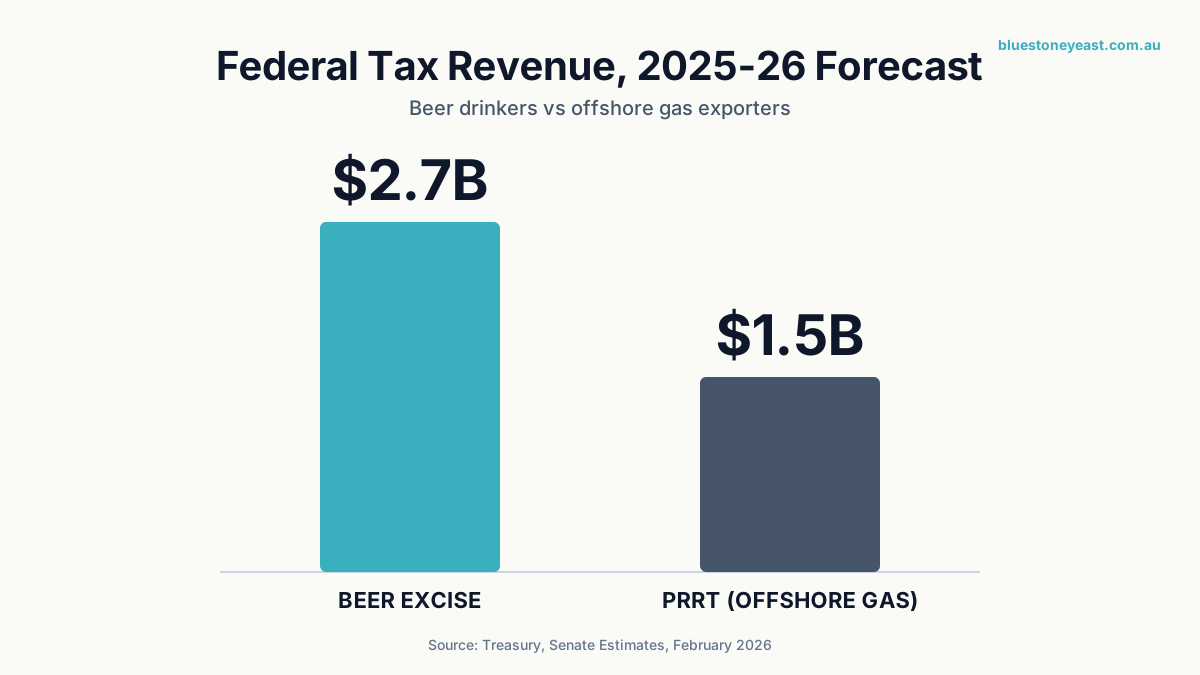
The 57-second clip went viral. Reporting puts it at close to 10 million views on Instagram alone. A snap Senate inquiry into gas taxation followed, with former Treasury Secretary Ken Henry telling the committee the system needed reform now. The Prime Minister has since ruled out a gas tax hike in the next budget, but the conversation is well and truly out of the bottle.
Once you put the numbers side by side, you can see the shape of a system that does not line up with the way we talk about Australian manufacturing, regional jobs, and local industry.
Two very different deals
Beer is taxed early, consistently, and without much flexibility.
Breweries do not get to wait until everything is sold, invoices are paid, margins are healthy, and the year has worked out nicely. Beer excise is triggered when the beer leaves the brewery. It is paid before the keg is tapped, before the carton is scanned, before the venue pays the invoice, and long before anyone knows whether that batch has actually made money.
That matters. It means tax is baked into the cost of beer right from the start. It sits inside cashflow. It hits production planning. It affects pricing. It flows through breweries, venues, bottleshops, and ultimately drinkers.
Gas is treated very differently. The PRRT is a profits-based tax on offshore gas projects. Companies deduct capital costs, operating costs, financing costs, and carry-forward losses, with an annual uplift, before PRRT meaningfully applies. The result is well documented:
- Santos paid zero corporate income tax for ten consecutive years on $47 billion in sales (ATO transparency data, 2013-14 to 2023-24).
- The Ichthys LNG project paid zero corporate tax and zero PRRT for six years on $43 billion in sales.
- Chevron paid its first PRRT instalment in August 2025, decades after starting to extract Australian gas.
That is not a loophole in the casual sense. That is the structure. And that is exactly the problem.
Beer pays early. Gas can defer.
Put the same numbers another way and the structural disparity gets sharper.
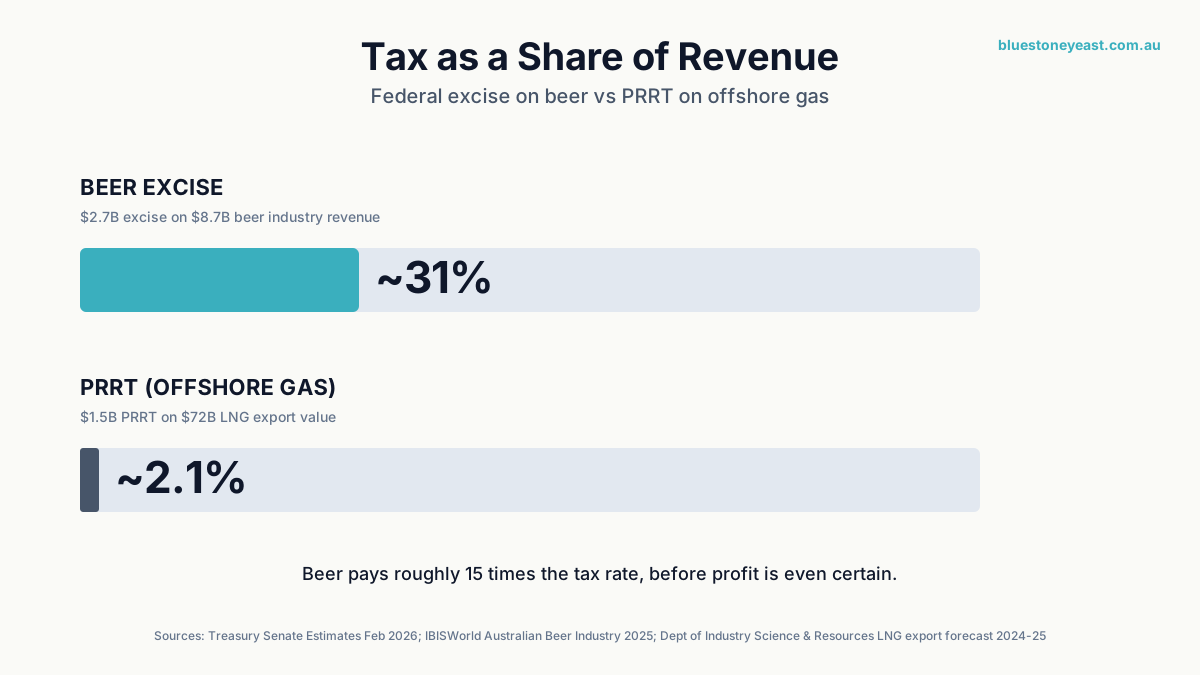
Beer excise is roughly 31 per cent of total beer industry revenue. PRRT is roughly 2.1 per cent of LNG export value. Beer pays the higher rate before knowing whether the batch will turn a profit. Gas pays its much smaller rate after a long list of deductions has been worked through.
The “$21.9 billion” claim
Since the Pocock clip went viral, the gas industry has been pushing back hard with a single number: $21.9 billion in taxes and royalties paid in 2024-25. It has shown up in industry submissions to the Senate inquiry, fact-checker pages on gas company websites, opinion pieces from political figures, and counter-advertising aimed at the public.
It is worth understanding what that figure actually contains.
According to public analysis published by Senator Pocock’s office, the $21.9 billion bundles together corporate income tax, PRRT, state royalties, excise, payroll tax, GST, and other levies. It includes consumption taxes that ordinary Australians ultimately pay. The cited source, an industry “Financial Survey 2025”, links through to an Australian Energy Producers media release rather than to survey findings. When the same numbers are reconciled against ATO company tax data, federal budget PRRT, excise data, and state royalty figures, the actual total looks closer to $19 billion in 2022-23 and an indicative $15 billion in 2023-24.
There is also a category problem. Royalties are not tax. They are payment for the public resource itself. And more than half of the gas exported from Australia attracts zero royalty payments at all.
If you compare like with like, the federal profits-based tax on gas (PRRT) against the federal excise on beer, the gap Treasury confirmed is real. The lobby’s response has been to redefine what counts as tax, and hope nobody checks the footnotes.
Beer money stays here
There is another difference worth naming.
Beer is not just a product. It is a domestic economic loop. Even if you are not particularly sentimental about beer, the structure is important.
Beer money moves through wages, trucking and logistics, packaging manufacturers, hospitality staff, venues and retailers, barley farms and maltsters, hop farms, equipment suppliers, local labs, and companies like Bluestone Yeast producing yeast locally for Australian breweries.
That money circulates through Australian communities again and again. It keeps regional suppliers busy. It keeps venues open. It gives farmers, maltsters, brewers, packaging suppliers, freight companies, and fermentation businesses a reason to keep investing here.
Gas is different. The resource comes from Australia, but a significant share of profits ultimately flows offshore through foreign ownership and global capital structures. While the gas itself is Australian, a lot of the wealth does not stay here. It leaves the country by the boatload.
For perspective: Norway has taxed petroleum profits at a combined 78 per cent since 1996. In 2024 alone, that system raised around AU$91 billion, money that flows into a sovereign wealth fund now worth roughly AU$1.9 trillion. Australia’s PRRT raised $1.5 billion in the same period.
What we are arguing about
The point is not that beer should be tax-free.
The point is that the settings are wildly out of balance.
One industry supports Australian agriculture, manufacturing, logistics, hospitality and regional communities, and pays upfront every time. The other extracts a public resource at enormous scale under a system that allows long deferral and significant offshore profit flow.
The Australia Institute has modelled a flat 25 per cent tax on gas exports, which they estimate would raise around $17 billion a year. Recent YouGov polling commissioned by the Institute (1,502 voters, March 2026) found 61 per cent of Australians support that idea, with majority support across Coalition, Labor, Greens and One Nation voters. There is room to argue about the design. The current settings are harder to defend.
If we say we care about Australian manufacturing and regional Australia, the tax settings should reflect that. Right now, they do not.
What this means for brewing
The brewing industry survives because it is circular. Breweries buy from Australian farmers. They buy from Australian suppliers. They employ local people. They sell to local venues. The money moves around the country again and again.
At Bluestone Yeast, we are part of that loop. We manufacture yeast locally, develop fermentation nutrients for Australian conditions, and work directly with breweries to improve performance, consistency, and yield.
That might sound like a small corner of the economy, but this is exactly how local manufacturing works. It is not one giant headline. It is thousands of practical decisions made across farms, factories, breweries, labs, coolrooms, trucks, venues, and retail shelves.
If you believe in keeping brewing dollars circulating here, the simplest way to do it is to keep your supply chain local and keep investing in innovation inside the industry. That does not mean every decision is easy. Local manufacturing is hard. Independent brewing is hard. Running venues is hard. The margins are tight and the pressure is real. But if we want these industries to still be here in 10 years, we need to make deliberate choices now.
Beer is local manufacturing. Beer is agriculture. Beer is hospitality. Beer is logistics. Beer is community.
And yes, beer pays up.
The question is whether the industries extracting far larger value from Australian resources should be asked to do the same.
If you are reviewing fermentation performance, looking to optimise yield, or trialling new nutrient strategies, get in touch. We are here to strengthen Australian brewing practically, not politically. Learn more about our Nutrient Booster range or book a discussion to talk about your brewery’s needs.
For a quick catchup on what else has been happening at Bluestone, including High Country Hop, the new website, and the lead-in to AIBAs week, see the Autumn Catchup post.