

We had a great night on 14 May at the AIBA’s trophy presentation dinner, joined at our table by nine brewers we work with. Watching people you supply walk up for a trophy is one of the highlights of the year and I get tremendous joy seeing all of these brewers get recognised for their hard work.
Now because I am a total nerd/geek at heart I couldn’t help but want to ask some interesting questions of the results data. So below I have selected some interesting findings from my analysis of this years awards and compared with previous years. I hope you find these results as fascinating as me!
The 2026 awards by the numbers
Billed as one of the largest annual beer competitions in the world. So here are the raw stats for the 2026 field:
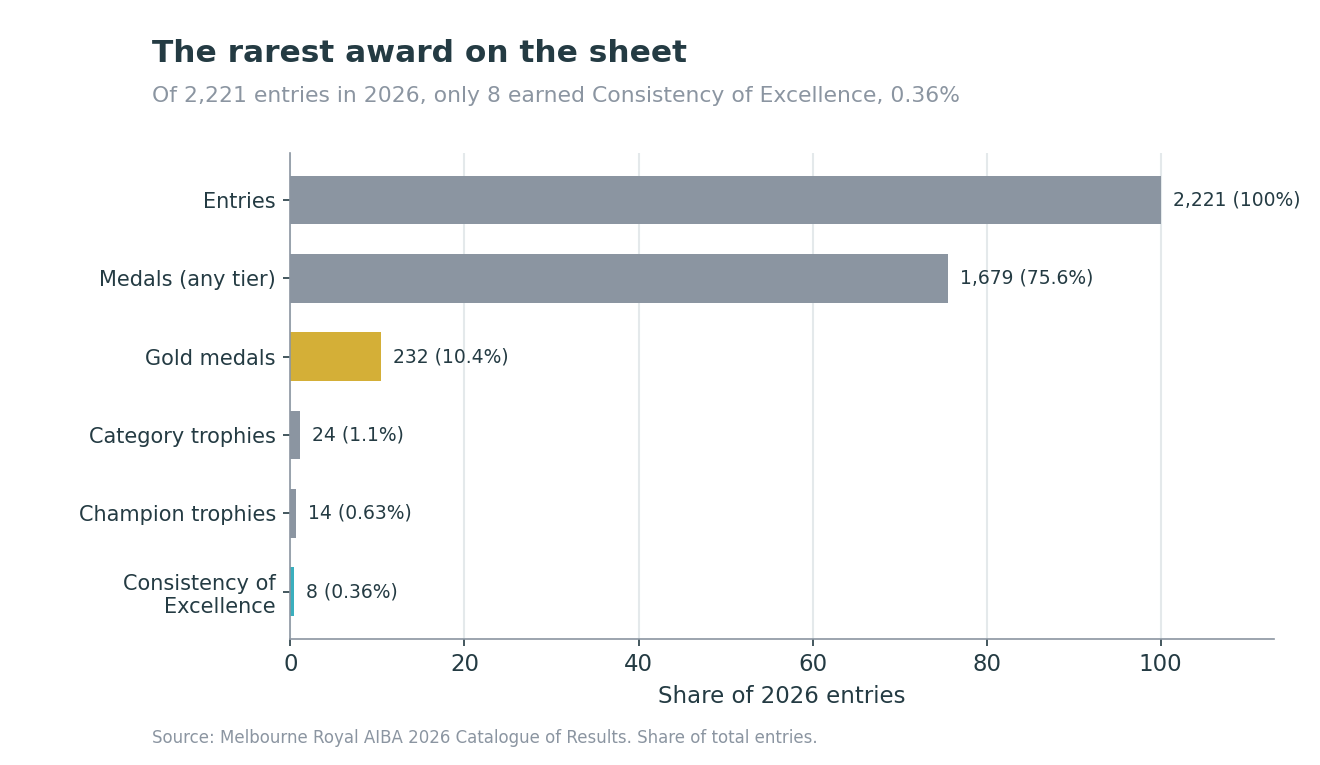
- 2,221 beer entries, judged across 24 categories and 142 individual classes
- 1,679 medals awarded: 232 gold, 672 silver and 775 bronze
- 379 exhibitors, from 22 countries
Mountain Goat took Champion Australian Beer for Bract To The Future, and China’s Zebra Craft Beer took Champion International Beer for its Weissbier.
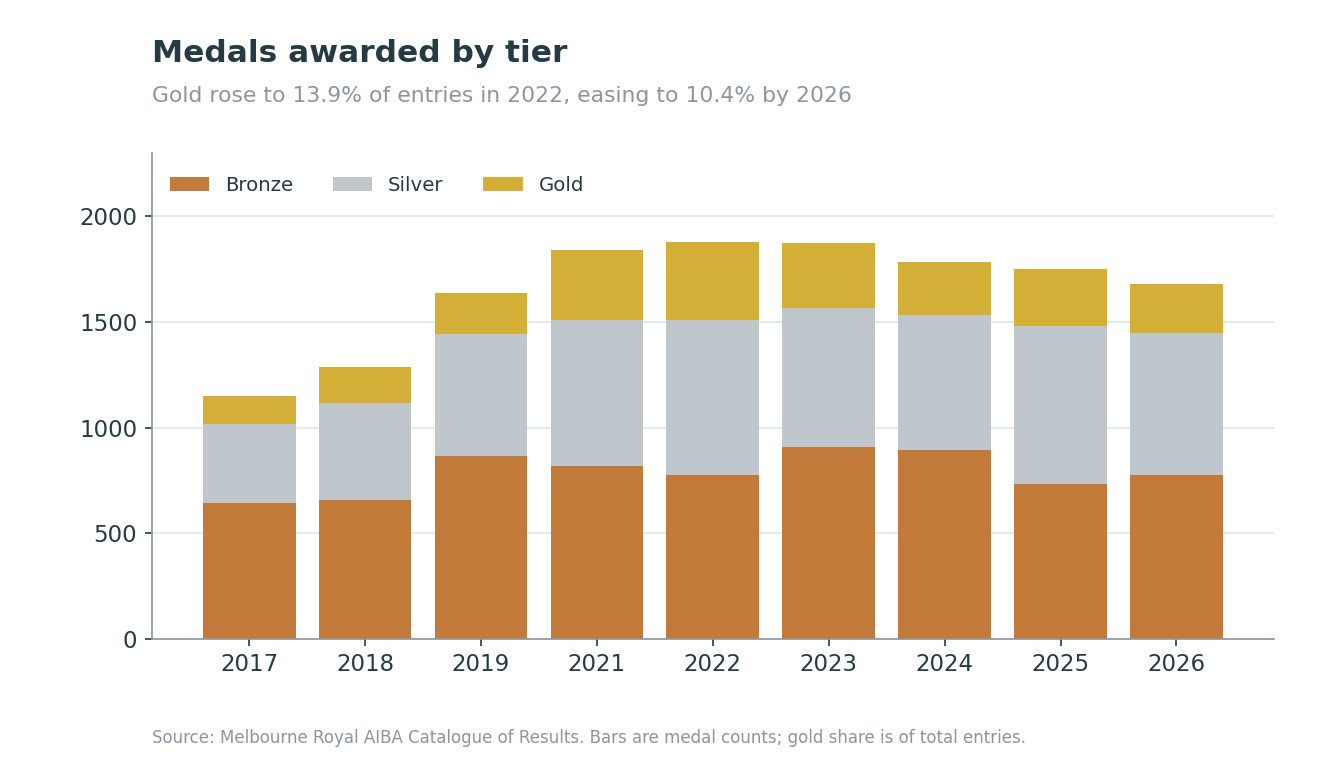
Everyone wants to get a Gold for their beer but it is the hard one to win. To give you a bit of an understanding of just how hard it is, I have tried to use the numbers to explain it. Gold made up 6.4% of beers entered back in 2017, peaked near 13.9% in 2022, and sat at 10.4% in 2026. A gold still means a beer cleared a genuinely high bar and 2022 was the year for the best tasting beer.
But there is an award rarer still, and in my opinion it should be the highest honour of the night: the Consistency of Excellence Medal. A gold says you brewed a great beer once. This says you brewed the same beer, in the same format and class, to gold standard three years running. You cannot win it on one good brew day, no matter how good the beer is, which is exactly why I rate it as the hardest thing to win on the sheet.
The numbers back that up, and the fairest way to measure it is over the long run. Over the past decade just 35 beers have ever earned it, from 21,886 entries, about one in every 625. That is a clean rate, ten years of awards set against ten years of entries.
The single year tells the same story from another angle. Of this year’s 232 gold medals, only 8 were a third gold in a row, roughly one in 29. Even among the beers good enough to take gold, only a handful had held that standard three years running. Winning gold once is about a one in ten result in any given year, so stringing three together is exponentially harder. The ladder below shows where that lands in a single year, rarer even than the champion trophies.
This year’s Consistency of Excellence winners were:
- Brick Lane Brewing Co, Victoria, for two beers, Asylum and Last Train Home
- Beerfarm, Western Australia, for their IPL
- Pirate Life Brewing, South Australia, for Mosaic
- Reckless Brewing Co, New South Wales, for their Red IPA
- TWOBAYS Brewing Co, Victoria, for their IPA
- Brouwerij L. Huyghe, Belgium, for Delirium Tremens
- Bierbrouwerij de Koningshoeven, Netherlands, for the La Trappe Quadrupel
Eight beers, seven breweries, three straight years of gold apiece. Hats off to every one of them.
Ten years of the AIBAs: A boom, then a cool down
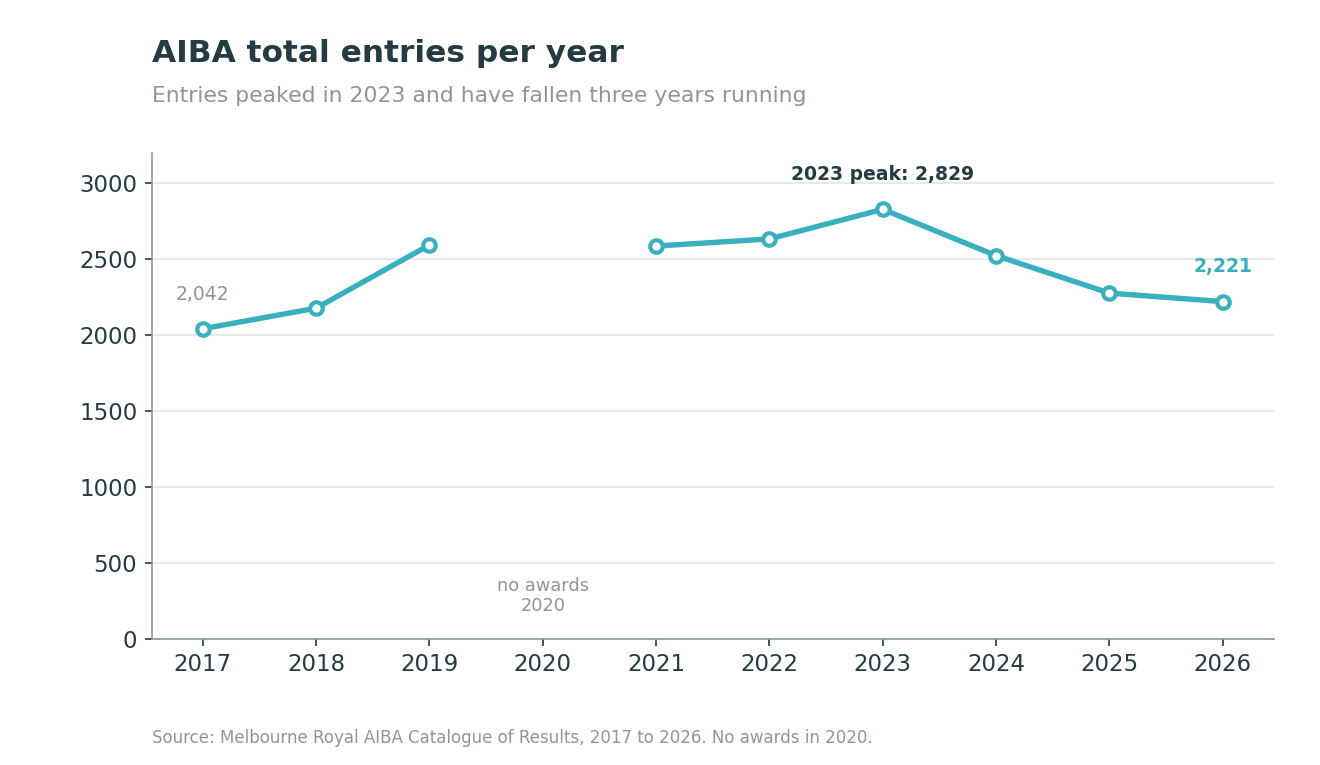
We pulled the entry numbers from every results catalogue back to 2017. The arc is clear. The competition grew strongly into 2019, held high through the post-Covid years, peaked in 2023, and has come off each year since.
| Year | Entries | Exhibitors | Countries |
|---|---|---|---|
| 2017 | 2,042 | 355 | n/a |
| 2018 | 2,178 | 359 | n/a |
| 2019 | 2,594 | 402 | 26 |
| 2020 | no awards (Covid) | ||
| 2021 | 2,587 | 402 | 21 |
| 2022 | 2,634 | 355 | 20 |
| 2023 | 2,829 | 405 | 21 |
| 2024 | 2,524 | 412 | 23 |
| 2025 | 2,277 | 391 | 22 |
| 2026 | 2,221 | 379 | 22 |
The 2026 field is about 21% smaller than the 2023 peak, though still a touch above where it sat in 2017. That cooling mirrors what the wider industry has been through, with closures and consolidation across 2024 and 2025.
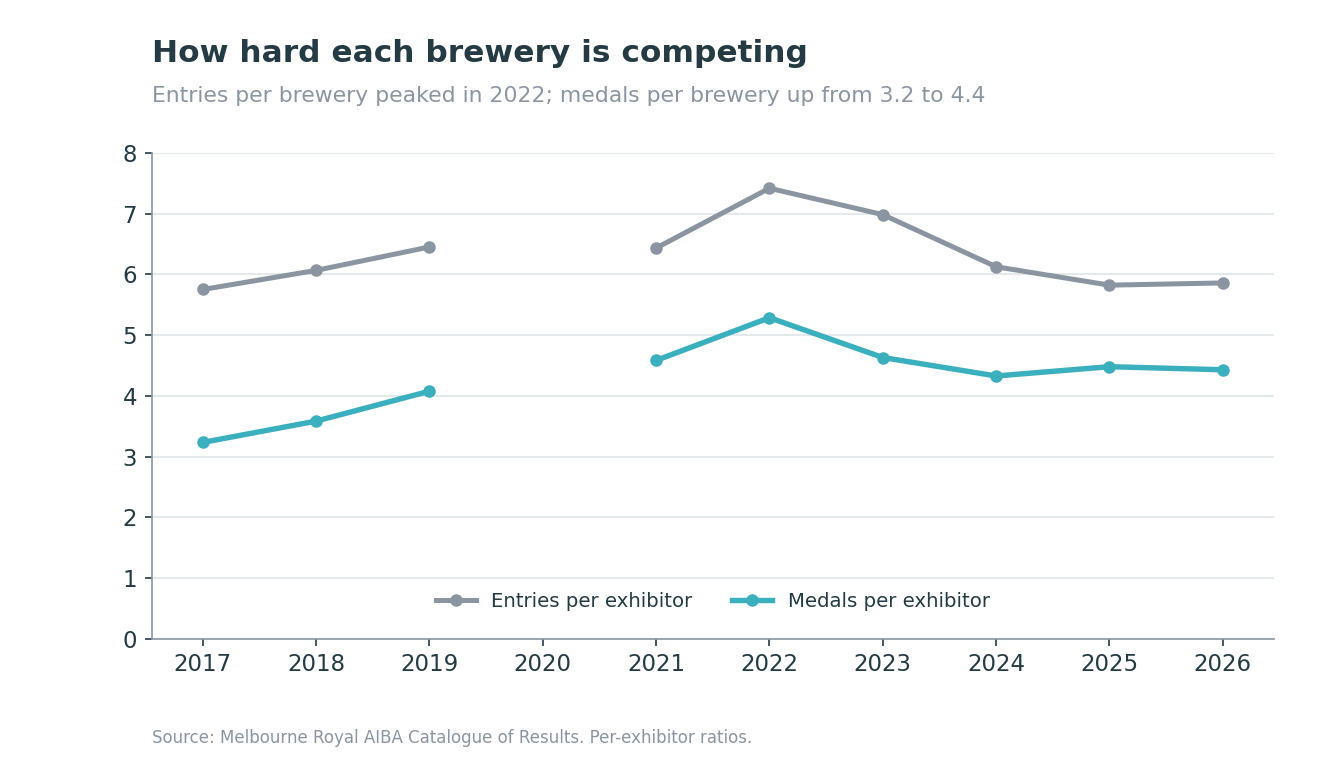
Two details stand out. First, 2024 had the most exhibitors of any year on record, 412, even as total entries fell. More breweries entering fewer beers each is consistent with brewers being more selective. Our read is that cost and caution are part of that, though the numbers alone do not prove why. Second, brewers are competing about as hard as they did a decade ago, just from a smaller field: entries per exhibitor have held steady near 5 to 6, while medals per exhibitor have risen from 3.2 to 4.4, which tells me that the overall beer quality continues to improve.
What is being entered: the quiet rise of lager
At the single-class level, IPA still owns the top of the table. The biggest class in 2026 was Best Modern India Pale Ale with 205 entries, with Best Traditional India Pale Ale right behind on 196.
But group the classes into style families and a different picture emerges. Lager is the largest family in the show, at 494 entries, its highest share of the field in the ten years we measured. IPA, for all its class-level dominance, is actually off its own 2023 peak. The story under the headlines is lager, not hops. This mirrors our sales data. Ever since Hop Nation won Best Pilsner for Rattenhund in 2021, brewed with our Pilsen yeast, we have seen a steady rise of brewers looking to make award winning lagers with high quality yeast.
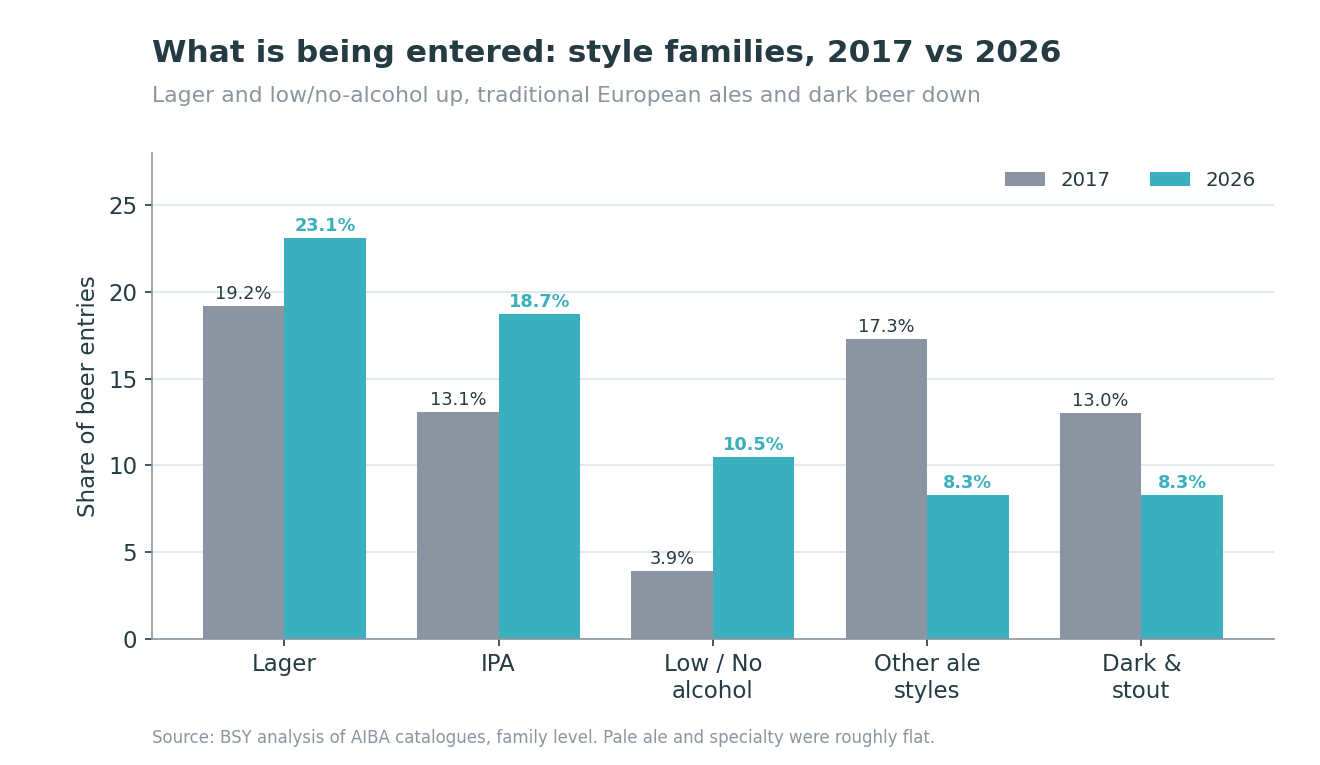
The other clear move is lighter beer. Low and no-alcohol has gone from a niche to a structural category, nearly tripling its share of entries since 2017. I remember listening to Matt Kirkegaard from Brews News debate the merits of non-alcohol beer, and highlight that its rise was off a very small base. Well the numbers seem to be in and it is definitely here to stay. At the other end, the traditional European ale styles, wheat, Belgian, British and Scotch ales, have fallen the hardest, not stout as you might expect. Will we see a swing back to some of those traditional styles in the coming years? I hope so, I love a strong Belgian or traditional English bitter or an imperial stout. Side note, you can sample some of these styles at Stomping Ground and Bodriggy, but get in quick as I know that Stomping Ground already sold out of their Belgian triple and Bodriggy sold out of their cans of imperial stout (still on tap though).
Inside the lager surge, the growth is broad. Australian-style lager has nearly doubled since 2017, and pilsner is up about 40%.
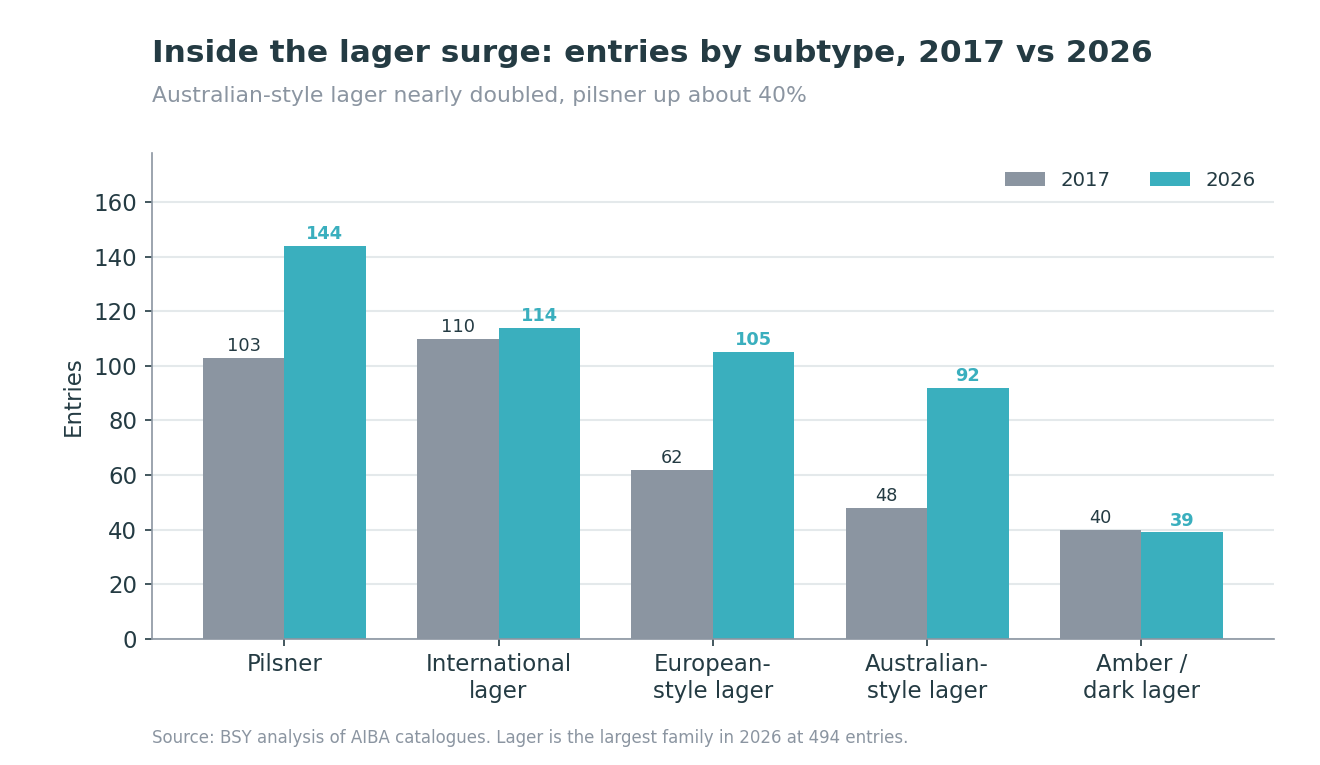
There is a reason lager rewards attention. A clean, well-attenuated lager leaves nowhere to hide a tired or under-pitched yeast. It is the category where fermentation consistency does the most work, and where it most clearly separates a medal from an also-ran. You can tell when a lager is brewed with a shake and bake and you can tell when it is brewed with premium quality Australian liquid yeast!
A genuinely global competition
Australia made up the bulk of the field, but the international side is where some of the most interesting movement is. After Australia, the largest contingents in 2026 were China (42 exhibitors), the United States (35), Thailand and New Zealand (18 each), Japan (8) and Germany (5).
China being the largest international contingent is the headline, and it is not just turning up in numbers. Zebra Craft Beer took Champion International Beer, and Chinese producers also picked up other category wins. The growth of craft brewing across Asia, China and Thailand in particular, has been one of the clearer trends in this competition over the last few years.
Final word
Congratulations again to every brewer recognised this year, and thank you to the nine who joined us at the table. Fresh yeast is one part of a good beer. The rest is the people who brew it, and this year’s results are a reminder of how much talent there is in the breweries we get to work with.
If you brew lager, you are competing in the biggest and most crowded category at the show, where fermentation consistency is the difference. If you want to talk through where your range sits against where the awards are heading, book a 15-minute fermentation planning call: https://calendly.com/derek-bluestoneyeast/yeast-management-discussion
Source: Melbourne Royal Australian International Beer Awards Catalogue of Results, 2017 to 2026 (no awards in 2020). Style-family and lager-subtype figures from Bluestone Yeast’s analysis of the catalogues, compared at family level because class definitions changed over the decade.